Job Interview Answers That Actually Work (With Real Examples)
Job interviews are not just about answering questions—they are about telling your story in a way that builds trust, confidence, and clarity. Many candidates assume that interviews are a test of knowledge or technical ability. But in reality, by the time you are invited for an interview, employers already believe you are capable of doing the job. What they are really evaluating is how you communicate, how you think, and whether you are someone they want to work with.
This is why even strong candidates often fail to convert interviews into offers. They either overcomplicate their answers, sound unprepared, or fail to present themselves with clarity and confidence. The good news is that interview skills are learnable. With the right structure and mindset, you can turn even basic answers into powerful impressions.
In this guide, we will break down four of the most common job interview questions and show you how to answer them effectively using simple, clear, and professional language.
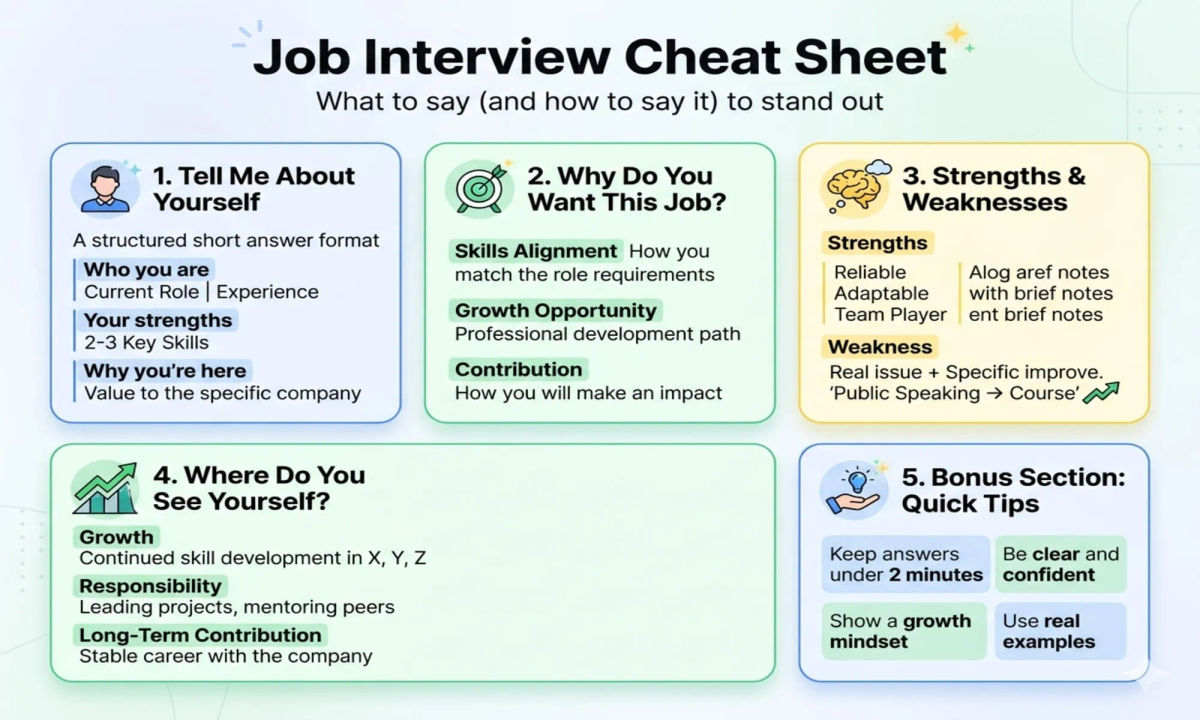
🎯 Tell Me About Yourself
This is usually the first question in any interview, and it sets the tone for everything that follows. Many candidates make the mistake of either giving a life story or providing a very short, vague answer. The goal here is not to repeat your resume but to present a clear and confident summary of who you are and why you are a good fit.
A strong answer should include:
- A brief introduction
- Your key qualities or strengths
- Your interest in growth and learning
- A connection to the role
✅ Sample Answer
- My name is Sophai. I'm a motivated and reliable person who enjoys learning and improving my skills.
- I'm especially interested in developing myself through work experience, working well with others, and taking responsibility.
- I'm known for being organized, adaptable, and willing to learn.
- I'm excited about the opportunity to contribute and grow with your team.
💡 Why This Works
This answer is simple, clear, and structured. It focuses on qualities that employers value—reliability, adaptability, and willingness to learn. It also ends with enthusiasm about the opportunity, which leaves a positive impression.
⚠️ Common Mistakes to Avoid
- Giving too much personal information
- Speaking for too long without structure
- Sounding unsure or unprepared
- Not connecting your answer to the job
💼 Why Do You Want This Job?
Your answer to this question can make or break your chances of landing the job. Employers are looking for candidates who are not just applying because they need a paycheck, but because they genuinely believe in what the company stands for and see potential in how their skills and ambitions align with the role’s requirements. A well-thought-out response that demonstrates passion and understanding can set you apart from other applicants.
✅ Sample Answer
I am eager to join this organization because it offers a unique blend of challenges and opportunities that resonate deeply with my career aspirations. For instance, the company’s focus on innovation aligns perfectly with my interest in cutting-edge technology and product development. Moreover, the supportive team environment at [Company Name] will provide me with an invaluable learning experience where I can grow professionally while contributing meaningfully to projects from day one.
💡 Why This Works
This response effectively communicates several key points that employers value: a clear alignment of personal and professional goals, enthusiasm for the company’s mission and culture, and a proactive approach towards growth and contribution. By mentioning specific elements like “cutting-edge technology,” it showcases research into the organization and genuine interest rather than generic platitudes.
⚠️ Common Mistakes to Avoid
- Talking solely about financial benefits or perks without addressing how you fit into the team dynamic.
- Giving vague, overused phrases like “I need a job” that do not show consideration for why this particular position is right for you.
- Failing to convey excitement and interest in what sets the company apart from competitors.
- Not illustrating how your career goals connect with the role’s responsibilities and future prospects within the organization.
⚖️ What Are Your Strengths and Weaknesses?
When asked about your strengths and weaknesses, it's crucial to strike a balance between self-promotion and honesty. Many interviewees fall into the trap of either boasting excessively or trying to mask their flaws entirely. Instead, you should aim for a balanced approach that highlights your genuine strengths while acknowledging areas where you are working on improvement.
For instance, in discussing strengths, it's beneficial to mention attributes like reliability and an eagerness to learn. By emphasizing these traits, you demonstrate not only competence but also a willingness to grow professionally. Another strength worth highlighting is adaptability; being able to adjust quickly to new situations shows that you can thrive in various environments. Additionally, showcasing your teamwork skills and organizational abilities further reinforces your value as a candidate.
✅ Sample Answer (Strengths)
- I am reliable and always eager to learn from every experience I encounter.
- My commitment to my responsibilities means that I consistently strive for excellence in all aspects of my work.
- I possess the ability to adapt swiftly to new circumstances, making me versatile and resilient in dynamic settings.
- Maintaining a high level of organization while collaborating effectively with colleagues is another hallmark of my professional approach.
✅ Sample Answer (Weakness)
- A challenge I face is initial nervousness in unfamiliar environments, but this doesn’t define my overall performance or potential.
- The more comfortable and familiar I become with a new setting, the more confident and effective I tend to be.
- To address this, I am taking proactive steps such as thorough preparation beforehand and actively engaging in conversations to overcome any initial hesitation.
💡 Why This Works
This approach illustrates several key qualities that employers look for. Firstly, it demonstrates self-awareness by acknowledging personal challenges while also showing a commitment to growth through action-oriented steps. Secondly, honesty is evident in the recognition of areas needing improvement without detracting from your overall value.
Employers understand that perfection isn't realistic; they are more interested in seeing evidence of continuous development and an ability to reflect on one's own performance critically.
⚠️ Common Mistakes to Avoid
- Avoiding the question by saying, “I have no weaknesses,” can come across as insincere or arrogant.
- Listing fabricated strengths like being a "perfectionist" without concrete examples might mislead employers about your true capabilities.
- Mentioning a weakness that is central to the job requirements undermines your suitability for the position, highlighting areas where you may fall short in crucial skills.
- Failing to illustrate how you are addressing and improving upon your weaknesses can make it seem like you lack initiative or drive towards personal development.
🚀 Where Do You See Yourself in the Future?
When an interviewer inquires about your future aspirations, they are assessing your long-term commitment and alignment with the company's growth. Employers prefer candidates who show foresight and a willingness to evolve within their organization.
Your response should illustrate how you plan to contribute by developing technical skills, taking on leadership roles, and staying committed to the company’s mission. This demonstrates ambition and a proactive approach towards personal and professional growth.
✅ Sample Answer
In five years, I see myself as a seasoned professional with deep expertise in my field, mentoring newcomers and driving innovative projects within our team. My goal is to become more confident and proficient, adding greater value through strategic contributions.
“I aim to take on increasing levels of responsibility over time, contributing meaningfully to the organization’s success while ensuring a stable career path for myself.”
This answer goes beyond generic platitudes by offering concrete insights into your engagement with both your role and the broader company context.
💡 Why This Works
- Demonstrates long-term thinking about professional development.
- Shows commitment to continuous learning and skill enhancement.
- Aligns personal career goals with organizational objectives, indicating mutual benefit.
Avoid vague statements or unrealistic expectations. A balanced approach that reflects ambition while staying grounded often resonates well with interviewers looking for practical professionals who are also aspirational.
⚠️ Common Mistakes to Avoid
- Avoid dismissing the question outright by saying “I don’t know.”
- Steer clear of unrealistic goals disconnected from your current role.
- Ensure your plans align with company responsibilities and culture.
- Avoid responses indicating a lack of direction, enthusiasm, or long-term commitment to the organization.
In essence, addressing this question thoughtfully can reveal your proactive attitude towards career progression within the company’s framework.
🧠 The Real Secret to Interview Success
Many candidates mistakenly believe that acing an interview is solely about giving perfect answers. However, how you present yourself—your tone, clarity, and confidence—is equally important. During my last job search, I noticed that while some candidates rattled off impressive facts and figures, those who communicated clearly and confidently stood out to hiring managers.
Keeping your responses simple enhances interview performance. Break down achievements into digestible pieces to leave a positive impression. This clarity not only makes you easier to understand but also demonstrates effective communication skills at all levels.
Stay Structured
Organizing thoughts and answers logically showcases mental acuity and professionalism. For example, when discussing challenges, briefly describe the issue, explain your approach, detail actions taken, and conclude with the outcome. This structure helps manage time wisely and makes it easier for the interviewer to follow your thought process.
Showcasing a growth mindset is important because employers value candidates who are willing to learn from their mistakes and seek feedback. Discuss past experiences where you turned setbacks into opportunities for learning and development. For instance, one candidate spoke candidly about using a missed deadline as a chance to refine planning and communication skills.
Being honest is crucial; authenticity builds trust with the interviewer. Instead of bluffing your way through technical questions, it's better to admit when you don't know something. Saying "I haven’t worked specifically on that aspect before, but I’m excited about learning more if given the chance" shows maturity and a willingness to learn.
Lastly, while many candidates prepare by rehearsing answers in their heads, speaking them out loud is far more effective. Practicing aloud helps refine fluency and confidence. For example, you could record yourself answering common interview questions or practice with a friend who can provide feedback on your delivery and content.
🎯 Final Thoughts
In interviews, employers prioritize capability, reliability, and a willingness to learn over perfection. Clear and confident answers leave lasting impressions. During my last job search, I was asked about my greatest weakness. Instead of dodging or cliché responses, I acknowledged an area for improvement and the steps taken to address it.
This honesty resonated with the interviewer. Examples in this guide are straightforward because simplicity is key. Employers value clarity of thought and genuine communication over elaborate vocabulary or memorized responses. Honesty and self-awareness showcase your strengths and enable you to handle unexpected questions smoothly.
Your resume secures initial meetings, but strong communication skills—both verbal and written—are crucial for job offers. This means being prepared to discuss experiences openly and honestly during interviews. A well-structured approach combined with thoughtful preparation can significantly impact how an employer perceives your fit.