7 Unwritten Office Rules That Actually Get You Promoted
Most professionals believe that promotions are a direct result of hard work, long hours, and consistently meeting expectations. While these factors certainly matter, they are rarely the deciding elements when it comes to career advancement.
In reality, promotions are influenced by a set of unwritten office rules—subtle but powerful behaviors that shape how others perceive your value, leadership potential, and readiness for the next level. These rules are not documented in job descriptions or performance guidelines, yet they play a critical role in determining who moves forward and who remains stuck.
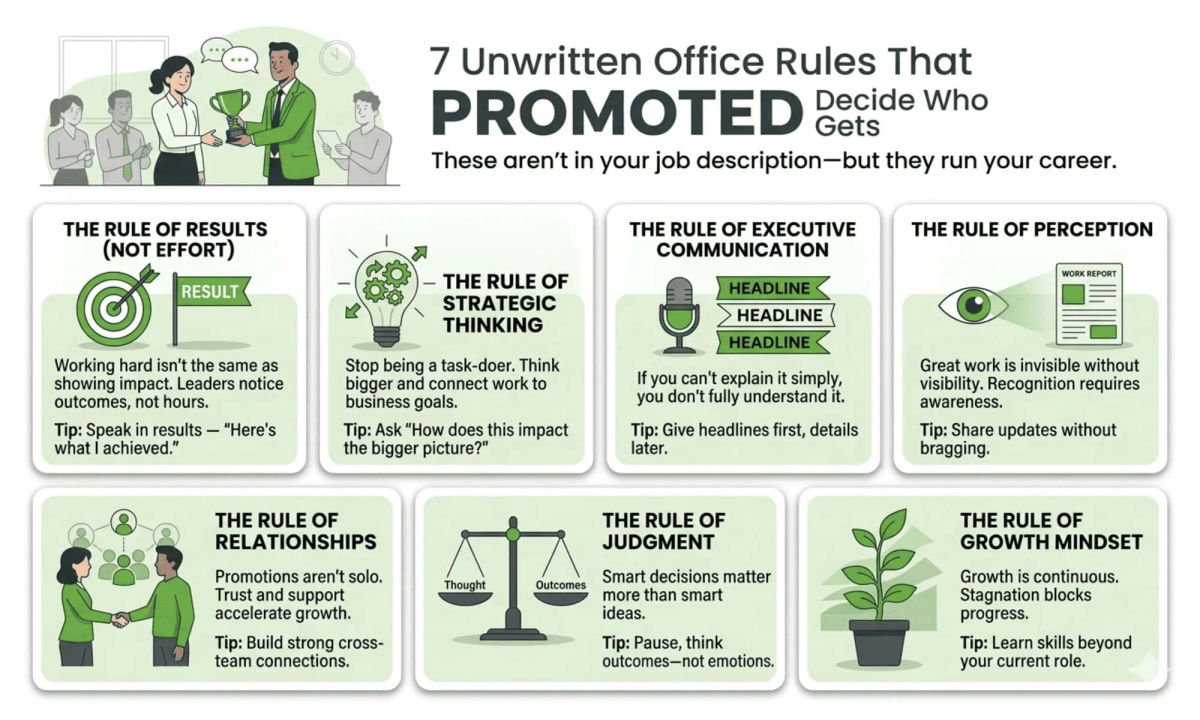
As the image rightly highlights, promotions don’t go to the busiest individuals—they go to those who are most intentional. Understanding and applying these principles can fundamentally shift how your career progresses.
Let’s explore the seven unwritten rules that quietly decide who gets promoted.
The Rule of Results (Not Effort)
One of the most common misconceptions in the workplace is that effort automatically leads to recognition. Many professionals take pride in how hard they work, the long hours they put in, and the number of tasks they complete. However, leadership does not evaluate effort in isolation—they focus on measurable outcomes.
Working hard is important, but it is not the same as delivering meaningful results. Organizations operate on impact, not activity. A person who spends ten hours on a task with minimal outcome will always be overshadowed by someone who delivers a clear, valuable result in less time.
To align with this rule, it is essential to shift how you communicate your work. Instead of focusing on what you did, emphasize what you achieved. For example, rather than saying, “I worked on improving the report,” say, “I streamlined the reporting process, reducing turnaround time by 30%.” This subtle shift reframes your contribution in terms of business value.
Ultimately, promotions are awarded to individuals who consistently demonstrate that their work moves the organization forward. Effort is expected—but results are what get noticed.
The Rule of Strategic Thinking
At early stages in a career, success is often defined by execution—completing assigned tasks accurately and on time. However, as you move toward leadership roles, expectations evolve. You are no longer evaluated solely on what you do, but on how you think.
Strategic thinking involves stepping beyond immediate tasks and understanding the broader context. It requires asking questions like: How does this work contribute to larger business goals? Is there a more efficient way to approach this? What are the long-term implications?
Professionals who remain confined to task execution often struggle to break into higher roles because they are seen as operators rather than decision-makers. On the other hand, those who demonstrate the ability to connect their work to bigger objectives are perceived as future leaders.
Developing this mindset means actively seeking context, anticipating challenges, and offering solutions that align with organizational priorities. When you consistently think beyond your current role, you begin to operate at the level above it—making your promotion a natural next step.
The Rule of Executive Communication
Communication is one of the most underrated yet powerful skills in career growth. It is not enough to have good ideas—you must be able to express them clearly, concisely, and effectively.
As highlighted in the image, if you cannot explain something simply, you do not fully own it. Leaders value clarity because it reflects structured thinking and confidence. Complex explanations, excessive details, or unclear messaging can dilute even the strongest ideas.
Executive communication is about delivering the headline first, followed by supporting details. For instance, instead of walking through every step of a process, begin with the conclusion or recommendation, and then provide context if needed. This approach respects time and demonstrates maturity in communication.
Strong communicators are often perceived as more competent and leadership-ready because they make decision-making easier for others. Over time, this skill becomes a significant differentiator, especially in promotion discussions.
The Rule of Perception
A difficult but important truth in the workplace is that quality of work alone is not always visible. Many professionals assume that if they perform well, recognition will naturally follow. However, without visibility, even excellent work can go unnoticed.
Perception is not about office politics—it is about ensuring that your contributions are seen and understood. Leaders cannot evaluate what they are not aware of, and in fast-paced environments, it is easy for impactful work to remain hidden.
Building the right perception involves proactive communication. Regularly updating stakeholders, sharing progress, and highlighting key achievements ensures that your work is recognized without appearing self-promotional. The goal is not to boast, but to provide clarity on the value you bring.
When perception aligns with performance, opportunities increase significantly. When it does not, even high performers can be overlooked.
The Rule of Relationships
Career growth is not a solo journey. While individual performance matters, promotions often involve trust, collaboration, and influence—factors that are deeply tied to relationships.
Organizations are built on networks of people, and decisions are influenced by those networks. Professionals who invest in building strong, genuine relationships across teams are more likely to gain support, visibility, and advocacy when it matters most.
This does not mean engaging in superficial networking. Instead, it involves building credibility, offering help, and establishing trust over time. When people respect and trust you, they are more likely to recommend you, support your ideas, and include you in important opportunities.
As the image suggests, your network often becomes your next opportunity. Those who understand this early tend to navigate their careers more effectively.
The Rule of Judgment
Technical skills and intelligence are valuable, but what truly distinguishes leaders is judgment—the ability to make sound decisions, especially under pressure.
In real-world scenarios, challenges are rarely straightforward. There are trade-offs, uncertainties, and competing priorities. Leaders are expected to navigate these complexities with calmness and clarity.
Good judgment is reflected in how you respond to situations. Do you react impulsively, or do you pause and evaluate? Do you focus on short-term fixes, or consider long-term impact? These behaviors are constantly observed, even if not explicitly acknowledged.
Developing strong judgment requires experience, reflection, and a willingness to learn from mistakes. Over time, it becomes one of the most critical factors in determining leadership potential.
The Rule of Growth Mindset
The final rule is about continuous evolution. In today’s fast-changing work environment, staying static is not an option. Skills that are relevant today may become outdated tomorrow, and roles continuously evolve.
A growth mindset involves proactively learning, adapting, and preparing for future demands. It means seeking opportunities to develop skills that are not immediately required but will be valuable in the long run.
Professionals who embrace growth are seen as forward-thinking and resilient. They do not wait for change—they anticipate it. This mindset signals readiness for greater responsibility and positions them as long-term assets to the organization.
As the image highlights, you cannot outwork stagnation. Growth is not optional—it is essential.
Key Takeaways
These unwritten rules reveal a consistent pattern: promotions are less about isolated performance and more about impact, perception, and readiness for the next level.
Focusing on results, thinking strategically, communicating effectively, building visibility, nurturing relationships, demonstrating sound judgment, and continuously growing are all signals of leadership potential.
Conclusion
Promotions are not random events. They are the outcome of consistent behaviors that align with organizational expectations—both spoken and unspoken.
By understanding and applying these unwritten rules, you move beyond simply doing your job well. You begin to position yourself as someone who is ready for more responsibility, greater impact, and leadership.
In the end, the question is not whether you are working hard.
The question is whether you are working in a way that makes your growth inevitable.